Sunday, April 9, 2017

Good Morning Call: Japanese Live-Action Anime Drama Show

            You might recognize the title of this show, as it is based on a manga written in the 90s by Yue Takasuka. The show was adapted to a live-action drama in 2016 and is available for stream on Netflix. The show is so melodramatic it hurts, but I could not stop watching it and finished the series in a week.
            The story centers on Yoshikawa Nao, high school student who ends up living alone in Tokyo. However, upon moving into her new apartment, it just so happens that she will be rooming with the most popular boy in school, Uehara Hisashi. The series follows their unfortunate (or fortunate) circumstance as they frequently bump heads but end up falling in love, of course.
            Right off the bat, we have that convenient coincidence in which Nao just so happens to be living with one of the “three hottest guys” in school. Nao’s actions throughout the course of the show embody melodrama: she has these little moments of daydream that depict her fantasies right in the middle of a conversation with another character. The opposite person always acts confused when she finally snaps out of it back to reality. Nao is also excessively dramatic in all her emotions, only seeming to express one at a time, making the whole show at times very cringe-y but innocent. Whereas Nao is overly dramatic, her roommate Uehara is not dramatic enough, as he displays no emotion whatsoever, often coming off very cold and mean. This polarity makes me question how even Nao and Uehara ended up together since their personalities are so different.
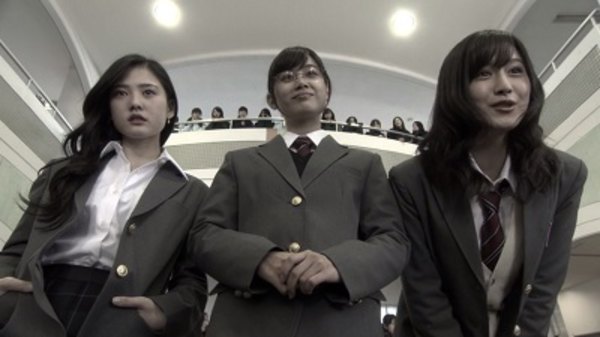
            Finally, there are just so many ridiculous situations in the show I cannot name them all. Towards the beginning episodes, Nao allows herself to me bullied by these three girls that are jealous of her and Uehara’s fake relationship (meant to cover up the fact that they are breaking school rules by living together). The girls are being really nasty to Nao when Uehara happens to walk in on them and goes to save Nao. This all happens in an obscure storage room in back of the gym at the school, by the way. Oh, the coincidence!

            Good Morning Call reflects so many qualities of melodrama. I recommend watching it, if you have Netflix.

Saturday, April 8, 2017

The Drama that Launched 1000 Other Dramas

It would be no understatement to say that Hana Yori Dango has profoundly shaped the world of Asian romcom melodramas since its first adaption. 

Originally published as a shoujo manga by Yoko Kamio, under the title 花より男子 or "Boys Over Flowers", the story has been adapted into 7 separate live-action dramas. In order of release, they are:
  1. Meteor Garden (2001, Taiwan)
  2. Meteor Garden II (2002, Taiwan)
  3. Hana Yori Dango (2005, Japan)
  4. Hana Yori Dango Returns (2007, Japan)
  5. Boys Over Flowers (2009, South Korea)
  6. Metero Shower (2010, China)
  7. Kaisi Yeh Yaariaan (2014, India)
The Taiwanese adaption Meteor Garden (流星花園) was so stupidly popular, it was quickly followed by a sequel, and then years later, a main land adaption of the Taiwanese adaption. I chose to watch this adaption in part because it is the first, but also because I nostalgically remember it as the show that brought my mother and auntie to tears. It was their marathoning of Meteor Garden that first introduced to me the idea of pulling an all-nighter. 

The basic plot goes like this: a hard working girl, Shan Cai in this adaption, ends up entering a school for rich children due to some reason. The school's social hierarchy is dominated by a group of four handsome, and rich, boys colloquially called the "F4" or Flower 4. They hand out red cards to those who cross them and these red cards are tacit permission for anyone and everyone to bully the holder, usually to the point of withdrawal from the school. Shan Cai is a just and up-righteous hard-working girl whose friend gets red carded. On behalf of her friend, she stands up the the leader of the F4 who is, of course, the most handsome, the most rich, and the most petty. Her actions earn her a red card too. But unlike others, Shan Cai preserves and continues to study and work hard - earning the respect (and love) of the F4 along the way.

After they go through a period of misunderstandings and fights, the main character and the main F4 get together. But this is no happy ending for afterwards comes, angry and spiteful mothers, jealous ex-girlfriend, accidents and memory loss, and fiances and arranged marriage.

Without any evidence, I'd wager that many of the hall-mark tropes of Asian Dramas can be found in Hana Yori Dango. Like any good melodrama, it features a lot of "being in the right place at the right time" and "being in the wrong place at the wrong time to get the perfect misunderstanding that leads to romantic angst". It is filled to the brim with tropes. But its enduring popularity across a wide population suggests there is more to HYD than a vapid melodrama.

Personally, I think that reason lies in the main female lead, whatever her name may be. Invariably, she comes from a poor working class background. Through a stroke of fate, or luck, she ends up attending a rich private school. In Meteor Garden, she attends the rich children's college because her parents truly believe that is the best thing for her. This sentiment probably strikes a chord with all viewers of Chinese/Taiwanese backgrounds: how can any of us not relate to the sacrifices a parent is willing to go through to provide the best possible education? And she is hard-working and just. When Shan Cai alone rages against the injustice of the system, the viewer agrees with her. Shan Chai is so brave! But at the same time, the viewer must ask: why doesn't anyone else do this? As the viewer observes the student body and faculty bow and cower before the power of F4's money, it is impossible not to think of the current Asia. Even 16 years later, Meteor Garden strikes a chord in the materialistic culture that Asia still exhibits.

And ultimately, the viewer feels that Shan Cai, for all her suffering and trials, deserves to live with the love of her life - who just so happens to be filthy rich and can provide a life of comfort and luxury.

Tuesday, April 4, 2017

Washington Square (1-59)

The beginning of "Washington Square" reminds me of the Brooks Introduction on Melodrama, especially the fact that the author "applies pressure to the gesture...to make it give up to consciousness its full potential as 'parable'. Even though the story is about Catherine, the author had to first recount the story of how Dr. Sloper came to be and how Catherine was born and how he had felt towards her. He also introduced several key characters, such as Mrs. Penniman and even Catherine, with the same pressure that allows the readers to fully understand their character. While this may seem like a violation of the "show not tell"  principle in storytelling, it is only with such understanding that we are able to fully comprehend the drama of an otherwise ordinary romance story.

It is the occasional peeks into Dr. Sloper's mind that we discover just how much he dislikes Catherine, his very own daughter whom he unfortunately named after his wife and later found out that she can never fill her shoes as what he had expected. This can be seen quite clearly in the beginning of the book, where the author writes that Catherine was "decidedly not clever ... had no desire to shine (pg. 10)" and that "she disappointed him but the Doctor, on the whole, had been very kind to her (pg. 11)". It is so early on in this book that we see tensions between Dr. Sloper and Catherine. Had he named her after someone else other than his ex-wife, this would have been an entirely different story. This tension would soon be intensified after Catherine was introduced to Morris Townsend. Morris was extremely handsome, well-mannered and eloquent, and the fact that he seemed to fancy Catherine made it all the more impossible for her to resist. Ironically, Catherine's "average-ness" seem to be the cause for escalation in the story. Morris Townsend may not have been so successful pursuing other New York women, but his charm on Catherine was multiplied exponentially. This would slowly lead to their engagement prior to the Doctor's consent and mark the start of his increased interference in their affairs

Going back to Brook's piece on Melodrama, all of these wouldn't have been revealed had the author not painstakingly write every thought that each character ever had. While this might be difficult to read, based on the fact that the story follows not only the chronological sequence of events but also the multiple consciousness streams of the characters, it is the foundation at which drama is created and it is also what drives the plot.

Monday, April 3, 2017

Floating Clouds (Naruse Mikio)


In Floating Clouds by Naruse Mikio, the effects of post-war occupation era on Japan as a nation greatly reflect within the mentality and situations of Yukiko. As Catherine Russel explains it in “The Cinema of Naruse Mikio: Women and Japanese Modernity”, the people of of post-war Japan often felt out of place in the changing society. Yukiko, one of the victims of this change, illustrates the Japanese sense of displacement through her endless wandering and loneliness. It is through the melodramatic elements Naruse directs in this film that bring to light her listless lifestyle.


In Melodrama and Modernity, by Ben Singer, he states that “Melodrama as it is generally used today refers to a set of subgenres that remain close to the heart and hearth and emphasize a register of heightened emotionalism and sentimentality.” Examples of this emotional atmosphere and “sentimentality” definitely present themselves throughout the film. Yukiko’s memories of Da Lat with Kengo are flashbacked to in the beginning of the film, as well as referenced to with a heavy sense of nostalgia. Her endless sentimentality over her past illustrates the contrast between her psychological state during and after the war. During the war time in Da Lat, Yukiko had drive and motivation to start an independent life, triggered by her rape. However, after the war, Yukiko finds no motivation to start a new life. Rather she drifts in between independence and dependence on Kengo. This independence is usually short lived however, as she tries to cling to her past with Kengo, saying she cannot live without him. This perhaps becomes a symbol of the nation longing for the times of unoccupied pre-war Japan.  


Yukiko’s dependence on Kengo seems to have similarities to the “lacking subject”, as called by Jeffrey Dym in the “Pacific Affairs”. He describes that post-war women, often mothers, in Japan become these “lacking subject”s that “does not act according to its own will but acts following someone or something.” I wouldn’t completely agree that Yukiko doesn’t have her own will, but I would say that her will is determined by the actions and whereabouts of Kengo. She is lacking in terms of fulfillment without his presence and suffers from much loneliness. For example she wanders to wherever he’s moved to, often exploding into tears at the sight of another woman’s belongings in his abode. Yukiko also physically becomes a lacking woman when she has an abortion. She implied that she wanted to keep the baby and marry Kengo, but upon his encouragement she got an abortion. By becoming physically lack of child, mentally she continues to throw away her desires for the sake of following and being accepted by Kengo.

So Short is the Life of a Flower...

Floating Clouds explains the love story of Yukiko and Toshioka through utilizing a vast array of melodramatic tropes, from double-suicidal ideation, to heartbroken sobbing and clinging, to infidelity abound. While the audience is trained by the structure of the film to despise the disloyal Toshioka and pity the lovesick Yukiko, a deeper analysis of the story reveals that in this melodrama, the struggle between "good" and "evil" is merely an illusion. Yukiko and Toshioka are two sides of the same coin, with their melodramatic roles changing based on the perspective of their co-starring fellow characters. 
At a glance, Yukiko Koda is an unremarkably cookie-cutter melodrama heroine. After falling madly in love with a the married Toshioka during an affair in Indochina, she spends the majority of the film desperately trying to win his affections, only to be scorned again and again by her fickle ex-lover. While she originally assaults Toshioka with a barrage of insults during his first visit to her after they return to Tokyo, naming him for the cold monster that he is for only using her for sex, she all too quickly reconciles with him as they leave for a trip to an onsen. Her over-eagerness to forgive Toshioka for his insulting her in this scene becomes a common theme throughout the film, with his transgressions against her gaining in callousness while he appears less and less apologetic after each. Despite his icy attitude toward her growing, Yukiko submits herself to him more and more as the film progresses. While during their first fight she berates him for trying to keep both her and his wife, by the end of the film we see Yukiko give up on life, surrendering to the idea that even while she is on her deathbed, "women are everywhere" and Toshioka will never fully be hers. 
While it is easy to sympathize with our main heroine, and she is certainly a tragic character, she is hardly the only woman to suffer from lovesick betrayal during this film. In contrast, I would argue, she becomes the antagonist of the story if we shift our perspective to that of Toshioka's wife. The wife is seen at the start of the film crying due to her husband's shift in attitude; While she does not have proof that he has been unfaithful, she very well suspects that his heart is no longer hers since he has returned for Da Lat. For the rest of the movie, she is essentially out of sight and out of mind for both the audience and Toshioka himself, as the main plot is concerned more with Toshioka throwing Yukiko away for yet another woman, Osei. Yukiko and Toshioka's wife's situations parallel eachother, as both have been tossed aside thanks to the interference of another woman. We see Yukiko heartbroken at Toshioka's infidelity, and though she ultimately appears to forgive him, his affair with Osei haunts her until she dies. If Yukiko is in such tremendous pain due to Toshioka's actions, it can only be imagined how miserable Toshioka's wife must be, having her husband constantly away "on business" while her health takes a turn for the worst. Had Toshioka been more attentive towards her, or spent less money on his failed business and romantic endeavors and more on a life-saving surgery, the wife's life could have been saved. Her fate foreshadows Yukiko's; thrown away by a man who will never truly love her until it is too late as she succumbs to her illness during his absence. 
As we can se throughout the film, Yukiko may be a tragic heroine, yet her fate is still less miserable than that of Toshioka's wife. Though she spends the majority of the film chasing after the faithless Toshioka, she is still able to attempt to move hell and high water to be with him, whether it be through tracking him down to Osei's home, marrying a conman and embezzeling hundreds of thousands of yen, or mustering the last of her strength to move to Yakushima with him. Meanwhile, Toshioka's wife remains the true picture of melodramatic purity and goodness, staying faithful, if heartbroken, until death extinguishes her life. Further, while her loyalty to her husband remains unrewarded with love nor a funeral from Toshioka, Yukiko's efforts are repaid in tears as Toshioka weeps bitterly over Yukiko's corpse. The lack of any consideration to the plight of Toshioka's wife paints her, not Yukiko, as the true tragic heroine of Floating Clouds. 

Floating Clouds

Before I begin to dissect the characters and their relationship, I'd like to discuss the major aspects of the film itself. An interest place to start is the story's context in history. One must take into consideration all literature created that centers around Postwar cultures in order to understand why this film plays out the way it does. Postwar America and Postwar Japan literature have similarities in the way that it depicts the nation reeling after a world war. People are trying to build up the workforce, the economy, families, etc. However, when we compare to American literature, we must remember that although these films may depict somber moods and hardship, we won the war and it was reflected in more uplifting stories. This is the major difference when analyzing Japan's postwar nation. This film attempts to mask that depression with its notions of romance, but it is inherently a story about yearning.

One of the most important and repeated themes in this film is the transition between time. The story is told through a series of flashbacks. This is usually hard to do in film successfully, but Naruse does it in a way that tells the story fluidly. An editing tool that helps to do this is the "L-cut." This is when the audio from one clip will continue to play even as the picture cuts to another image. This technique is used to stitch an idea together even though there is a cut in the middle. Another technique successfully used in this film was the music. It wasn't overtly romantic, but it mimics the dance that Kengo and Yukiko do with each other and with themselves.

Time and almost everything else in this story push the couple apart, yet they remain in touch with each other. This creates the tension in the film that makes the story so engaging. This reveals that they need each other, not romantically or sexually, but rather because they are dependent on one another. Kengo embodies the character of "floating clouds" because he is not grounded anywhere nor to anyone. Additionally, he is not tethered morally and can't find full satisfaction no matter where or who he's with. Yukiko, on the other hand, longs for the most exciting time in her life and that time included her affair with Kengo. He reminds her of better and more prosperous times which is why she is so attached to him.

Saturday, April 1, 2017

Moonlight Drawn by Clouds

To be honest, I’m a Korean drama fan and I have learned a little Korean, so I love watching Korean dramas. I was really into the drama Moonlight Drawn by Clouds and could not stop watching it. It has attractive plots and it reflects aspects of melodrama.
       This drama is mainly talking about a love story in ancient Korea, but it is not just a normal love story. The main female character Hong Ra-on was raised as a boy and she was asked to not tell anybody that she was actually a girl, which made her life a little bit hard. From my perspective, Moonlight Drawn by Clouds is a great melodrama and it reflects on many parts of this drama. I would like to talk about some impressive scenes of this drama.
       Hong Ra-on was taken to the palace to let her be a chamberlain, but she was afraid of being found out that she was a girl. There was several time she could get caught, but she all got through those crisis. Although she was safe, it makes me so nervous when I watched those scenes. Those chamberlains had to pass the physical examinations before they entered the palace. I believe all the audiences will feel nervous when it was Ra-on’s turn, but she was always lucky.
The most exciting scene to me is the prince told Ra-on that he liked her in the garden of the palace. It is so romantic and I believe this scene will catch every girl’s heart. I believe romantic is one of the main reasons that Korean drama is popular in the U.S. The way of telling love stories of Korean drama is quite different from American drama, and audiences always want to see something new. After all, Korean drama is famous for its love stories.
Romance is not the only reason that Korean drama is popular all over the world, it also has dangerous and changeable plots, and full of contradiction and conflict, which are elements of melodrama. Moonlight Drawn by Clouds successfully reflects those aspects of melodrama and makes audiences feel nervous and follow the plots. Ra-on found out that she was the daughter of a rebel, and that is the reason she had to live as a boy. The love between the prince and Ra-on became really tough. Both of the prince and Ra-on didn’t want to hurt each other but life was not as they expected. Many evil counselors tried to set the prince up by using Ra-on. Those scenes made me very nervous and followed the plots.

In a word, Moonlight Drawn by Clouds is a great Korean drama and does well on reflecting aspects of melodrama.